Demographic Patterns Influencing Game Selection in Digital Casino Settings
Gisela Hughes · Aug 25, 2026
Demographic Patterns Influencing Game Selection in Digital Casino Settings
Researchers tracking player behavior across multiple platforms have documented clear connections between demographic variables and the games users select in digital casino environments, and these patterns emerge consistently when data gets segmented by age, gender, location, and income levels. Platforms record millions of sessions each month, which allows analysts to map preferences with precision, and the resulting datasets highlight how different groups gravitate toward specific categories such as slots, table games, or live dealer experiences.
Age Groups and Their Distinct Preferences
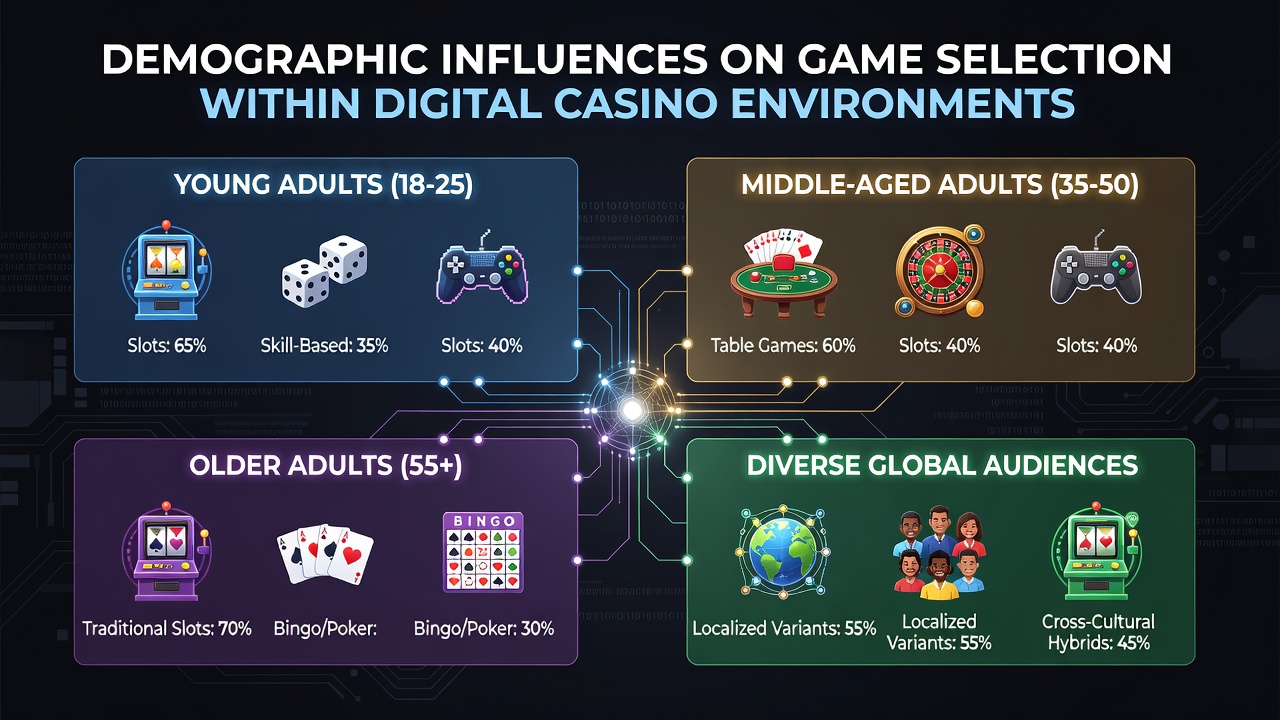
Younger adults between eighteen and thirty-five years old show stronger engagement with high-volatility slots and instant-win formats because these options deliver quick feedback loops and visual stimulation that align with shorter attention spans shaped by mobile-first habits. Data collected through August 2026 indicates that this cohort accounts for over sixty percent of sessions in progressive jackpot titles, whereas players aged fifty and above allocate more time to blackjack, roulette, and video poker where decision-making and pacing feel more deliberate. Observers note that older participants often complete longer sessions once they enter these games, and retention metrics reflect sustained play rather than rapid cycling through titles.
Gender-Based Variations in Game Choice
Women represent a growing share of digital casino users and demonstrate measurable differences in title selection compared with male counterparts, with studies revealing higher participation rates in bingo-style games, casual slots featuring themed narratives, and certain live dealer variants that emphasize social interaction elements. Men, by contrast, register elevated activity in poker rooms and sports-adjacent betting interfaces when those features appear alongside traditional casino offerings, and aggregate figures from platform operators confirm these splits hold across multiple markets. Researchers attribute part of the divergence to marketing exposure and part to inherent gameplay mechanics that resonate differently across genders.

Geographic and Cultural Influences
Location shapes access and taste because regulatory frameworks, payment methods, and cultural attitudes toward gambling vary by country and region, and players in North American markets display stronger interest in sports-integrated casino products while European users frequently favor live dealer tables and multi-player formats. Data from the American Gaming Association illustrates how state-level legalization timelines correlate with shifts in preferred verticals, and similar patterns appear when analysts examine activity in Australian and Canadian jurisdictions. Cultural familiarity with certain game types also carries over from land-based venues, which influences the speed at which new digital offerings gain traction among specific populations.
Income Levels and Spending Behaviors
Income brackets correlate with both game selection and average wager sizes, as higher-earning users concentrate activity in premium table games and high-limit rooms where stakes reflect disposable resources, whereas mid-range earners distribute play across standard slots and occasional jackpot chases. Platform telemetry shows that lower-income segments engage more frequently with low-stake entry points and promotional bonuses that extend session length without requiring large initial deposits, and these behaviors persist even after operators adjust for promotional targeting. Analysts at institutions such as the Canadian Institute for Gaming Research have tracked these distinctions across longitudinal datasets that span several years.
Additional Factors Including Education and Device Usage
Education levels intersect with demographic trends because users holding advanced degrees register higher engagement with strategy-heavy titles like poker and blackjack, and device preferences further refine these patterns since mobile sessions skew toward simpler, touch-optimized slots while desktop play correlates with deeper table game involvement. Platform operators segment traffic by these variables to optimize interface design and promotional offers, and the resulting personalization increases both acquisition efficiency and session duration across cohorts.
Conclusion
Demographic variables produce measurable, repeatable effects on game selection within digital casino environments, and operators who monitor these signals can align product catalogs with observed demand across age, gender, geography, and income segments. Continued data collection through 2026 and beyond will refine these understandings as new markets open and user bases evolve, which allows platforms to maintain relevance without relying on one-size-fits-all approaches.